For decades, email deliverability has lived in the background. It was viewed as a technical concern. When messages landed in spam, the default response was to tweak infrastructure, warm IPs, or simply “ask the ESP”. That perspective no longer holds true.
As we move into 2026, deliverability has evolved into a cross-functional discipline. Something that spans marketing, engineering, product, and compliance.
Major inbox providers like Gmail, Microsoft, and Yahoo now evaluate email programs holistically, looking beyond technical configuration to assess user experience, consent, and sender behavior across their entire lifecycles.
Deliverability is no longer something you simply fix after an incident. It’s something you must design into the email program itself with cross-functional discipline.
In other words: email deliverability in 2026 is shared ownership. When one part breaks, inbox placement can break with it.
TL;DR:
- Deliverability is no longer just technical: inbox placement in 2026 depends on relevance, consent, user behavior, and trust, not only SPF, DKIM, and DMARC.
- Mailbox providers evaluate the whole program: Gmail, Microsoft, and Yahoo look at engagement, complaint signals, unsubscribe behavior, and consistency across the lifecycle.
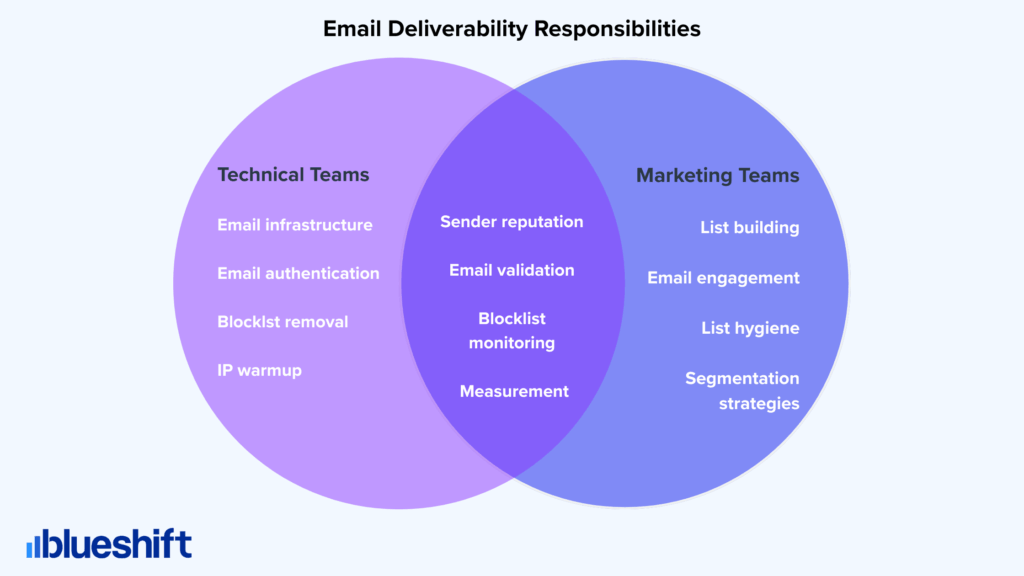
- Every team affects inbox placement: marketing controls relevance and cadence, engineering owns authentication and infrastructure, product shapes unsubscribe and preference UX, and legal defines consent and transparency.
- Poor UX is now a deliverability risk: broken or slow unsubscribe flows, confusing opt-downs, and ignored preferences directly increase spam complaints.
- Failures are faster and harder to spot: deliverability issues often show up as quiet engagement decline, not visible outages.
- High-performing teams treat deliverability as an operating model: shared metrics, regular reviews of tools like Gmail Postmaster Tools v2, and early issue resolution.
- For Blueshift customers, deliverability becomes proactive: unified data, preference management, consistent journeys, and governance help design inbox success into the program.
How the Deliverability Model Has Changed
Modern deliverability is shaped by decisions made across the organization. Each function now plays a direct role in inbox outcomes.
Marketing: Relevance, Cadence, and Audience Expectations
Marketing teams increasingly define deliverability through:
-
Message relevance and clarity
-
Sending frequency and timing
-
Segmentation and audience targeting
-
Managing engagement and avoiding fatigue
In 2026, inbox placement is inseparable from relevance. High complaint rates, disengaged audiences, or confusing messaging can jeopardize even a perfectly authenticated setup.
With the recent updates in 2025 by all major mailbox providers, they are analyzing how recipients respond in more ways than opens and clicks alone. Signals like how quickly a recipient reports an email as spam, and other post-open behavior patterns, can contribute to how ISPs profile you as a sender. That positive or negative activity can quickly divert mail to spam or keep it in the inbox.
Engineering: Authentication, Alignment, and Infrastructure
Engineering continues to own the technical foundation. For Blueshift customers, this part is already taken care of by us.
-
Mail routing, TLS, and sending infrastructure
-
Reliable unsubscribe and feedback loop processing
Deliverability failures in 2026 are rarely gradual. They are sudden, systemic, and costly because a single misconfigured DNS record or header misalignment can now cause widespread filtering, often without obvious warning. However, with Blueshift-managed infrastructure, the margin for error has narrowed.
Product: Unsubscribe and Preference Experience
Product teams now directly influence deliverability outcomes through. This part is partially shared between Blueshift and its partners.
-
Functional preference centers
-
Clear opt-down versus opt-out flows
-
Fast, reliable unsubscribe processing
Mailbox providers explicitly monitor whether unsubscribe requests are honored. As a result, user experience has become a deliverability signal. A poor unsubscribe flow is no longer just a UX issue. It’s a deliverability risk.
Legal and Compliance: Consent, Transparency, and Trust
Legal and compliance teams shape deliverability by:
-
Defining consent standards
-
Reviewing opt-in language and disclosures
-
Ensuring regulatory compliance (GDPR, CAN-SPAM, CASL, etc.)
-
Supporting transparency and user trust
Poor consent practices don’t just introduce legal risk, but they also drive complaints, which directly impact inbox placement. In 2026, trust is enforced at the mailbox level.
Why This Shift Matters
Mailbox providers are no longer asking: “Is this sender technically capable of sending email?”
They are asking: “Does this sender respect recipients?”
This question cannot be answered by a single team.
Deliverability today is the outcome of shared ownership, where marketing, engineering, product, and compliance all contribute to inbox success. When these teams operate in silos, issues surface quickly, and recovery becomes significantly harder than usual.
Why This Matters for Executive Teams
For business leaders, deliverability is no longer a tactical email concern. In 2026, it is a revenue, brand, and customer trust issue.
When deliverability breaks down:
-
Marketing performance declines
-
Critical customer communications fail silently
-
Engagement and retention suffer
-
Brand trust erodes
Because mailbox providers often filter quietly, these failures rarely look like outages. Instead, they show up as declining engagement, making them harder to detect without proper visibility and governance. Strong deliverability is now a reflection of strong organizational alignment.
What High-Performing Teams Are Doing Differently
The most effective email programs in 2026:
-
Treat deliverability as an ongoing operational discipline
-
Establish shared ownership and metrics across teams
-
Review tools like Google Postmaster Tools v2 collaboratively
-
Address unsubscribe, authentication, and engagement issues early
-
Build workflows to resolve issues before enforcement actions occur
They recognize that deliverability is no longer “just an ESP issue.” It’s a direct reflection of how the business communicates with its customers.
What This Means for Blueshift Customers
For brands using Blueshift, this shift presents a clear opportunity.
Blueshift operates at the intersection of data, orchestration, and customer experience, enabling teams to:
-
Send more relevant, well-timed messages that reduce complaint risk
-
Manage preference centers and unsubscribe workflows reliably
-
Maintain consistent sending practices across campaigns and journeys
-
Support compliance with Gmail and Yahoo’s evolving requirements
-
Proactively validate and monitor sending practices through upcoming platform enhancements
By bringing marketing execution, data, and governance together in one platform, Blueshift helps organizations operationalize deliverability, not as a reactive fix, but as a built-in capability.
In the 2026 email ecosystem, inbox placement is no longer about sending more email. It’s about sending the right email in the right way that respects users, aligns teams, and meets mailbox provider expectations.
After all, ensuring that 90% of your target audience gets into the inbox beats trying for 100% and getting 50% quarantined to the spam folder after complaints or unsubscribes arise.
If you have concerns about your inbox placement or would like to discuss how to improve email deliverability in 2026, feel free to connect with your Blueshift CSM about list validation or deliverability services.
FAQs:
What is one-click unsubscribe, and why does it matter?
One-click unsubscribe refers to header-based unsubscribe mechanisms (often tied to RFC 8058) that allow recipients to unsubscribe without friction. Mailbox providers treat this as a trust signal because it reduces spam complaints and improves recipient control.
What does “bulk sender” mean for Gmail?
Google defines a bulk sender as someone sending about 5,000 or more messages to Gmail accounts in a 24-hour period, and provides compliance tooling for these senders in Postmaster Tools.
If we have SPF, DKIM, and DMARC, are we “safe”?
Authentication is necessary, but not sufficient. In 2026, relevance, complaint rates, and unsubscribe experience are strongly tied to inbox outcomes. Authentication gets you eligible. Recipient trust keeps you delivered.
Why do deliverability problems feel harder to detect now?
Filtering often looks like slow performance decline rather than a visible outage. That is why high-performing teams review compliance status, complaint signals, and program consistency on a shared cadence.