After the noise of the last two years, most marketers are not asking “Should we use AI?” They’re asking a more practical question: Which kind of AI actually moves KPIs, and which kind just adds more output to manage? The confusion makes sense, because “AI” gets sold as one magical layer that makes everything better. In reality, it’s a set of different technologies, each good at a different job. Once you separate them, it gets much easier to spot where value is real, and where it’s mostly hype.
In fact, HubSpot reports that 66% of marketers globally use AI in their roles, which is exactly why the real question has shifted from adoption to impact.
In this blog, we’ll break down the AI marketing use cases that reliably improve performance, and how predictive, generative, assistants, and agentic AI work together to compound results.
What Types Of AI Should Marketers Actually Understand?
A useful starting point is to treat marketing AI like a stack, not a monolith. Most of what you’ll run into fits into six categories: Machine Learning (ML), Natural Language Processing (NLP), Large Language Models (LLMs), Predictive AI, Generative AI, and Agentic AI.
Machine learning is the foundation. It learns from customer and campaign data, detects patterns that are hard to see manually, and powers the recommendation and prediction engines found inside modern platforms.
NLP is how systems make sense of human language. It helps AI interpret what people are expressing in reviews, support messages, and feedback, so intent and sentiment can be captured and acted on instead of being buried in text.
LLMs are the “language layer.” They generate copy, adapt tone, and help teams create variations quickly, as long as they’re grounded in brand guardrails and the right context.
Then come the three categories marketers tend to feel most directly in their day-to-day work.
- Predictive AI is about likelihood and prioritization. It analyzes behavioral and transactional data, scores customers by intent, and supports next-best-offer and churn prevention decisions that feel timely instead of reactive.
- Generative AI is the creative accelerator. It produces copy and content variants quickly and makes it feasible to test far more ideas than a team could manually.
- Agentic AI is where things shift from “help me do this” to “run this for me.” It can act toward a goal by making decisions such as timing, channel, and spend, and it improves as it learns from results.
A simple way to remember how these fit together is the handoff: LLMs create language, predictive AI forecasts intent, and agentic AI acts and optimizes over time.
If you’re sorting out the boundaries, here’s a deeper comparison of agentic AI vs generative AI.
What AI Marketing Use Cases That Improve Performance Today?
If you’re looking for the best AI marketing use cases to start with, focus on workflows where inputs are clear, outputs are measurable, and results show up fast.
The quickest path to value is to stop treating this like “AI adoption” and start treating it like work improvement. Where are the repetitive tasks, the guesswork decisions, and the bottlenecks that keep performance from compounding?
In practice, AI most often makes an impact in six places.
- It shows up in content creation, where teams can generate more variants faster, but still need human review to keep voice and claims on brand.
- It improves advertising and targeting by tightening the match between the audience and the creative being served, and by optimizing toward higher-performing combinations.
- It strengthens segmentation by surfacing micro-segments based on behavior and value, which helps marketers stop treating large audiences as one blob and start tailoring to meaningful differences in intent.
- It supports customer experiences through faster support workflows, sometimes via chatbots, sometimes by assisting human agents with quicker, more consistent responses.
- It affects email performance through AI marketing use cases for email like subject line and copy variants, send-time optimization, and automated experimentation that improves opens and clicks over time.
-
It upgrades campaign analytics, where AI can detect patterns and anomalies, then surface recommendations faster than manual analysis typically can.
Notice the pattern: the biggest lift tends to come from systems that help teams decide better and test more, not just create more.
How Do Predictive, Generative, Assistants, And Agentic AI Work Better Together?
A lot of AI projects stall for one simple reason: fragmentation. When one tool writes copy, another holds audiences, a third runs orchestration, and performance data lives somewhere else, the loop never really closes. The system can’t learn cleanly, and teams end up doing the “glue work” manually.
A more effective model is to treat AI as a chain, where each part has a specific job:
- Predictive AI understands and forecasts intent
- Generative AI creates personalized content quickly
- AI assistants speed up execution while keeping the marketer in control
- Agentic AI acts in real time to automate next-best actions
When those pieces work together, AI stops being a set of isolated features and starts behaving like a compounding engine.
Many teams solve this by standardizing on a customer engagement platform that keeps data, orchestration, and measurement in one place.
How Predictive AI Shortens The Time Between Repeat Purchases
Here’s a common lifecycle challenge: customers make a first purchase, and then the second purchase takes months. Marketers try generic upsell flows, but results stay flat because the campaign isn’t focused on the people most likely to respond right now.
A predictive approach shifts the strategy from “message everyone” to “prioritize the highest-intent subset.” In the example from the deck, the marketer targets recent purchasers but narrows further using a predictive score, then pairs that with channel choice, send-time optimization, and product or category relevance.
The difference is not personalization for its own sake. It’s precision. The campaign becomes less about volume and more about timing, likelihood, and relevance.
How Generative Assistants Reduce Campaign Fatigue Without Changing The Campaign
Campaign fatigue is often a reality problem, not a creativity problem. Some industries must send frequent messages, and even good offers start underperforming when the experience feels repetitive.
One practical fix is to keep the intent and cadence the same while varying the expression. In the deck example, the goal is to rotate multiple CTAs so repeat messages feel fresher, using both a content assistant and a template assistant to make the implementation manageable.
This is a strong everyday use case because it doesn’t replace strategy. It removes the production bottleneck that keeps teams stuck with one version of the same message.
What An AI Agent Actually Does For A Lean Team
Optimization is where marketing results compound, but it’s also the first thing teams stop doing when workloads spike. Many programs run for months with the same subject line, the same framing, and the same assumptions, simply because there’s no time to test consistently.
That’s the gap an agent can fill. Instead of asking a marketer to remember to test, an agent identifies opportunities, generates variants, runs experiments, and reports winners once results are statistically meaningful.
What Marketing Myths Keep Teams Stuck?
A lot of hesitation around AI comes from myths that sound plausible, especially when teams have been burned by vendor hype.
One myth is that AI replaces marketers. In reality, the more durable value is that AI automates routine tasks so teams can focus on strategy and creative decision-making.
Another myth is that you need massive data to start. Modern systems can learn from quality, not just quantity, and even modest datasets can still drive meaningful personalization.
A third myth is that AI equals ChatGPT. Generative AI is only one component. Predictive and agentic AI are often where measurable ROI comes from because they connect directly to prioritization and optimization. And while some teams worry AI outputs cannot be trusted, the reality is that trust is designed: human oversight, brand guardrails, and explainable systems matter.
Finally, the most dangerous myth is that AI is plug-and-play magic. Results come from combining the right AI approaches with data and human context, not from turning on a single feature and hoping for impact.
How Do You Adopt AI Without Wasting Cycles?
Two frameworks help keep adoption grounded.
The first is the reminder that AI transformation doesn’t happen all at once, and trying to jump from baseline to full transformation usually fails. The journey matters, and expectation management is part of success.
The second is a practical evaluation lens: the 4Rs. Ask whether an AI capability is relevant to a real problem, whether results are reliable and repeatable, whether it supports responsible use, and whether it can sustain ROI at scale.
If you need an even faster filter before investing time, the deck also offers a short diagnostic: does it improve a KPI, can you measure quickly, does it integrate with your data and channels, does it support governance, and does it make your team faster or smarter, not just louder.
The Real Takeaway
The marketers who win are not the ones adopting AI the fastest. They’re the ones adopting it wisely: focusing on high-value use cases where predictive, generative, assistants, and agentic AI work together, applying the 4Rs to separate hype from impact, and measuring outcomes instead of chasing excitement.
The clearest path forward is to prioritize AI marketing use cases that drive ROI, where predictive, generative, and agentic capabilities reinforce each other and lift is visible in your core KPIs.
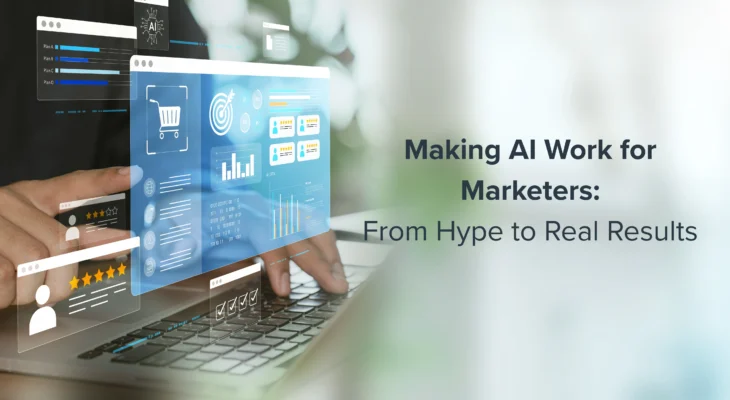
If you want to see what that looks like in practice, the webinar Making AI Work for Marketers: From Hype to Real Results walks through real examples and frameworks you can use to start getting measurable lift.