“The only metric that really matters is revenue. Everything else is a vanity metric. Unless that user makes a decision and makes a purchase, we haven’t hit our goal.”

Ken Pecca
Ken Pecca Marketing Operations Leader, U.S. News & World Report
30%
Revenue Lift
3.75M
Weekly Active Users
MoM revenue growth

At a Glance

30% revenue lift New revenue generated in the re-engagement campaign’s first month
2× MoM revenue growth Month-over-month revenue growth rate during the re-engagement push
1.5M → 3.75M Weekly active users grown by re-mining a stale subscriber base
36 campaigns in days New campaigns launched in days instead of the weeks it would normally take
1 week → hours Pre-launch QA (UAT) time cut from a week to hours

A Stale Audience, and an Opportunity for Growth

U.S. News & World Report is a leading provider of rankings, consumer advice, and journalism, helping millions of people make informed decisions about education, health, money, travel, real estate, and more. Across the web, mobile app, and dozens of email newsletters, that creates an enormous audience for the lifecycle marketing team to engage.

As Marketing Operations Leader, Ken Pecca owned the job of making sense of all of it: content, offers, and priorities that were constantly changing, and a lifecycle program that needed a faster way to plan, build, and optimize campaigns at scale.

One challenge was especially familiar: a “promo” channel of about 1.5M active users that rarely grew, because unengaged users quietly dropped and were never brought back.

Pecca saw re-engaging that audience as one of the company’s biggest growth opportunities. But he knew executing that strategy at enterprise scale meant overcoming three operational challenges:

  • Costly configuration mistakes: The most expensive lifecycle mistakes are usually configuration mistakes, not strategic ones: a mistimed trigger, an inherited segment, or a hidden suppression setting that can quietly sink a well-designed campaign, often invisible until performance is already bad.
  • Lost momentum across a campaign’s life: Real campaigns don’t get built in one sitting. They evolve through feedback, design changes, and new requirements, often over multiple sessions spread across weeks.
  • A vision stuck in planning: Pecca wanted to move off fixed weekly broadcasts toward a dynamic, personalized engine, but making that executable typically takes weeks of coordination across marketing, data, engineering, and operations.

Pecca began putting Blueshift’s Launchpad to work across each of these challenges, using agentic AI to help plan, build, review, and refine campaigns. What he wanted was to accelerate execution, increase confidence, and free up more time for strategy and customer impact.

“You have all the toys I want: Blueshift, the CDP, and being able to leverage data the way we want it.”

Ken Pecca, Marketing Operations Leader, U.S. News & World Report

Putting Launchpad to the Test

Before making Launchpad part of his everyday workflow, Pecca put it to work under real marketing conditions. He started with three scenarios: catching expensive mistakes before they ship, sustaining a campaign build across weeks of changes without losing context, and turning a broad vision into a build-ready plan in a single sitting.

Together, those experiences gave him the confidence to bring Launchpad into a live production workflow.

THE AUDITOR

An 8-Minute AI Audit That Saved a Re-Engagement Campaign

Pecca started with a real re-engagement campaign aimed at subscribers who had been inactive for 90–120 days. The strategy was sound. What he wanted to know was whether anything in the execution might undermine it.

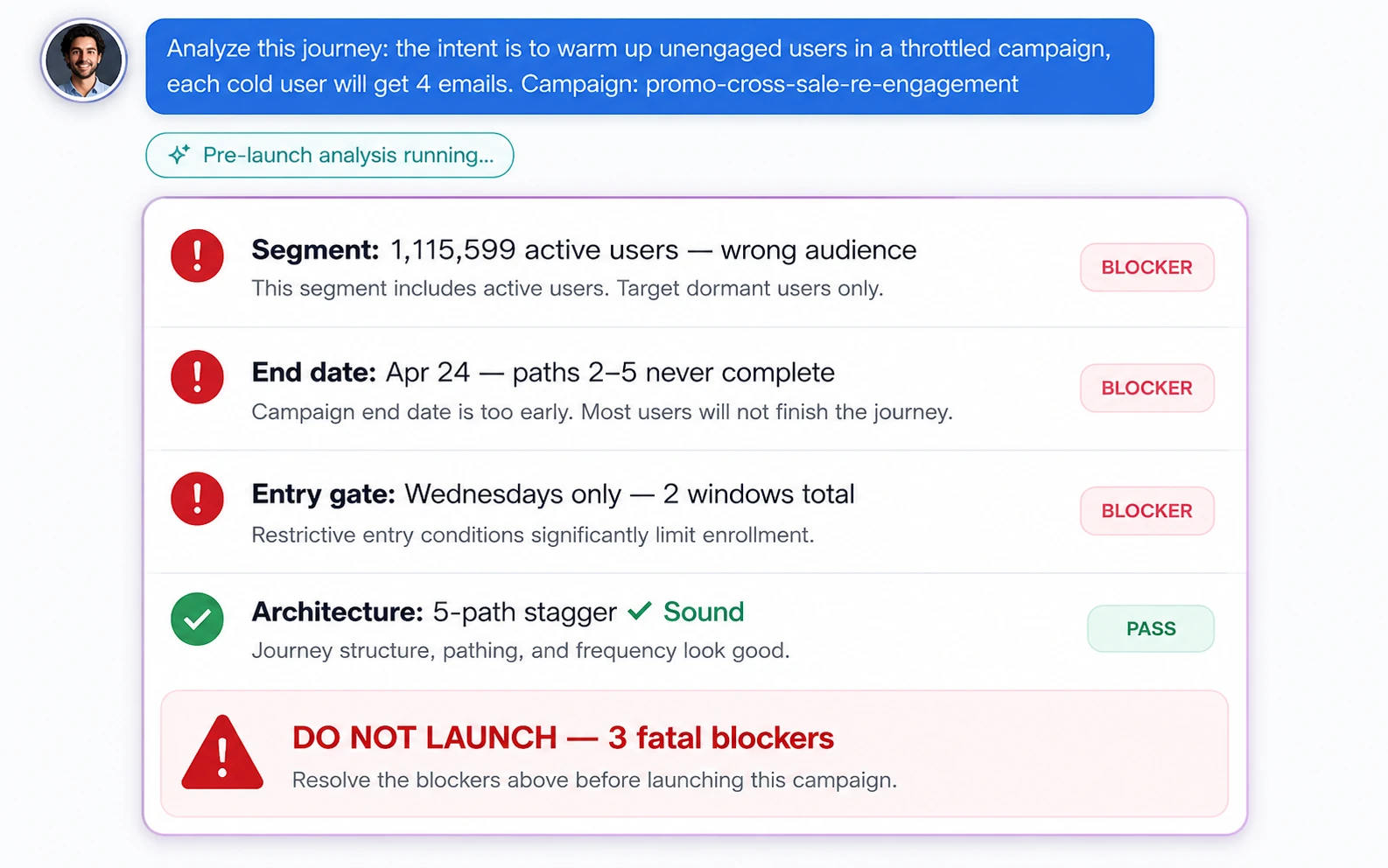
In a roughly 8-minute pre-launch review, Launchpad surfaced three issues that would have undermined the campaign:

  • A 1.1M-subscriber targeting error: The campaign was pointed at an inherited segment of more than one million active subscribers, not the dormant audience it was built for.
  • A schedule/end-date mismatch that would have cut off most users before they finished the journey.
  • Restrictive entry conditions that sharply narrowed the effective enrollment window.

It also flagged settings that could have silently suppressed emails, a missing conversion-based exit, and content that didn’t fully match the re-engagement goal.

Pecca corrected targeting, journey timing, and suppression risk before launch, fixing the problems in development instead of diagnosing them from poor results afterward. Same strategy. A more reliable path to it.

Catching a mistake before it ships is one kind of test. Keeping pace as a campaign evolves over several weeks is another.

THE BUILDER

One Ongoing Conversation That Turned a Brief into a Campaign

Pecca’s next question was whether Launchpad could keep up as a single campaign changed shape over weeks, not just build one from a clean brief. He treated it as a persistent collaborator across an entire campaign lifecycle: a single conversation that carried context the whole way.

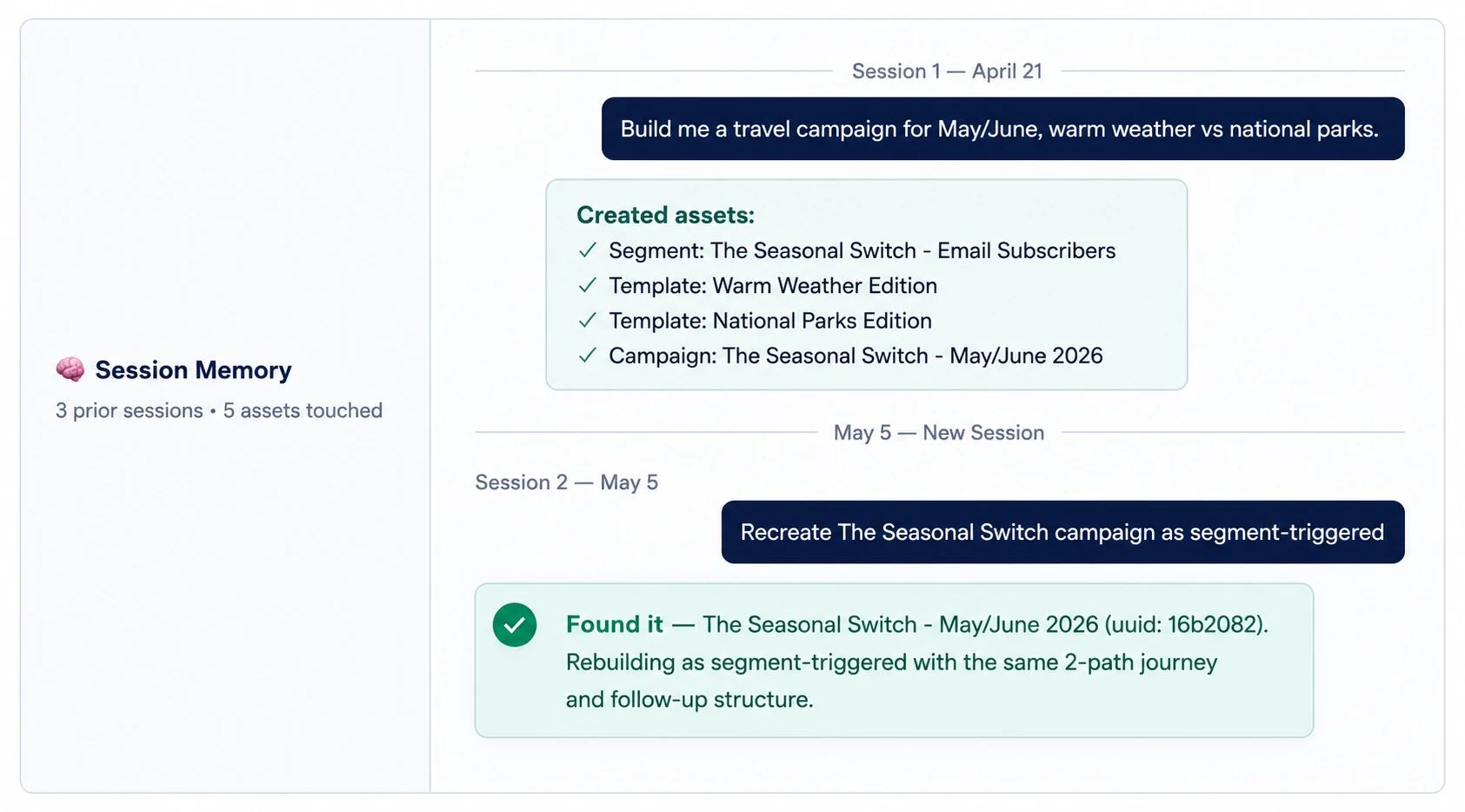
Week 1 – Foundation: From one brief (“a travel campaign, two audience themes, one shared destination”), Launchpad built the audience logic, two branded email experiences, and a personalized two-path journey.

Week 2 – Design: Pecca returned to the same conversation with a reference template. Launchpad already understood the campaign (no re-explaining) and applied the new layout across both emails in U.S. News branding while keeping the personalization intact.

Week 3 – Evolution: Pecca added a follow-up email for subscribers who opened but didn’t click. Launchpad extended the journey with recommended timing and audience logic. When a configuration locked at the campaign’s creation blocked the expansion, Launchpad identified the constraint, explained the tradeoff, recommended a path, and rebuilt the campaign in the correct format while preserving the earlier work.

The result: A production-ready, segment-triggered travel campaign with personalized paths and a multi-step journey, built through one continuous conversation across three sessions, with three major iterations and zero re-briefs.

THE STRATEGIST

A Single Conversation That Designed an Entire Lifecycle Program

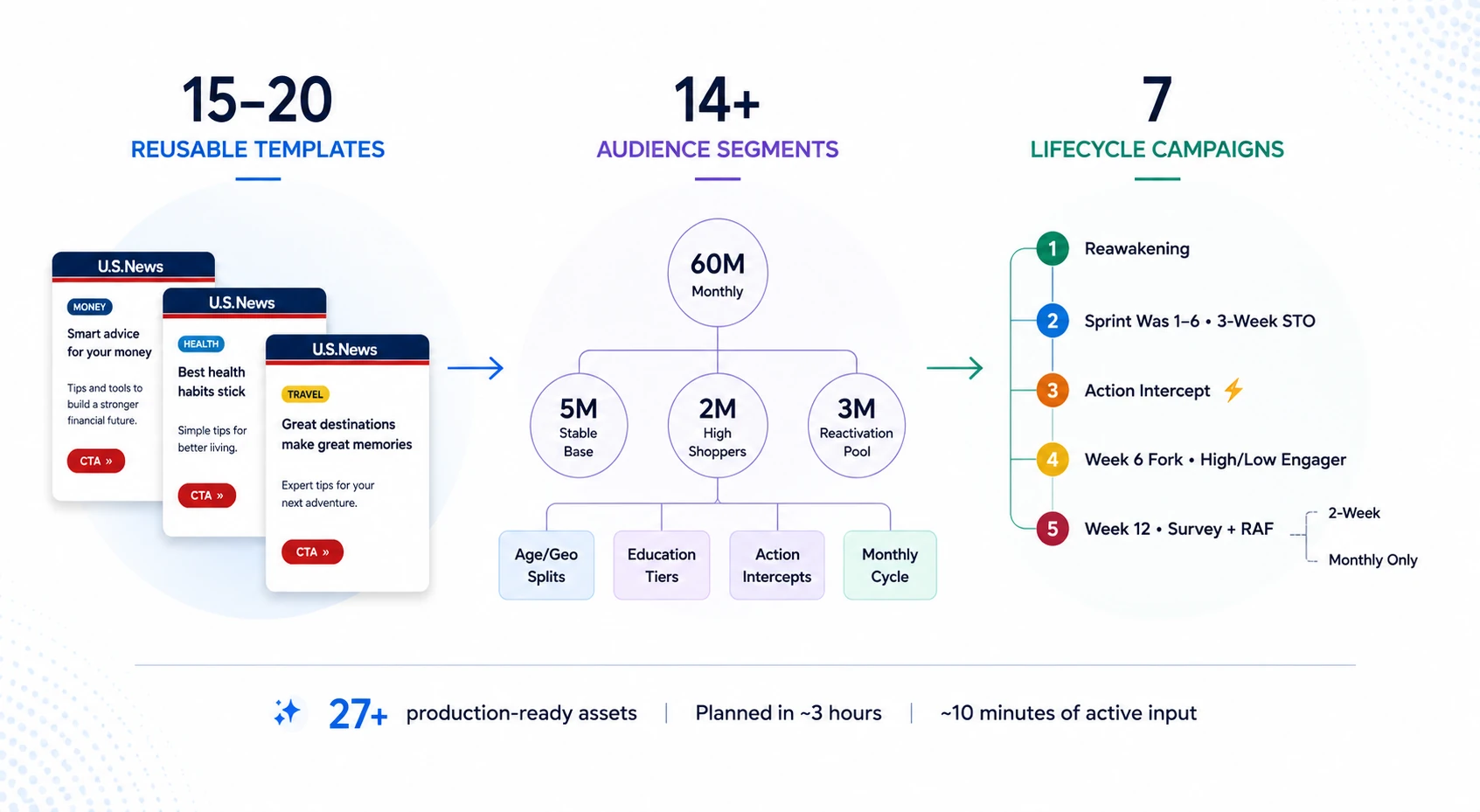
For his next test, Pecca started further upstream. Instead of bringing Launchpad a campaign already in motion, he brought it a vision for what U.S. News’s lifecycle program could become. In one working session, Launchpad turned it into a build-ready blueprint:

  • Engagement-driven cadence instead of fixed schedules: active users get more, less-active users are throttled to protect deliverability, and high-intent signals (e.g., an upcoming insurance renewal) can temporarily override the standard journey.
  • An eight-pillar content rotation across finance, travel, insurance, health, automotive, education, and more, with demographic signals routing each user.
  • A Liquid-powered template architecture so many personalized experiences run off a small set of master templates.

The plan was specific enough to start building immediately: 7 lifecycle campaigns, 14+ audience segments, 15–20 reusable templates, and 27+ production-ready assets. It also mapped the custom events, user attributes, third-party integrations, and five engineering workstreams required to bring the strategy to life, prioritized so the team could begin shipping value while more advanced capabilities progressed in parallel.

The whole plan came together in roughly three hours, with about ten minutes of Pecca’s active input.

By this point, Pecca had used Launchpad to catch problems before launch, carry context across weeks of iteration, and turn a lifecycle vision into an executable plan. Then came the real test: bringing all three together in a live production campaign.

All Three, Together

A Day in the Life: Turning 3.75M Stale Subscribers Into a Pet-Insurance Growth Engine

The first three tests each focused on a different part of the campaign lifecycle. This time, Pecca brought all three together on a live re-engagement campaign for U.S. News pet-insurance subscribers.

  • Friday: Strategy and build. From one prompt describing an existing segment and a re-engagement goal (users untouched for 180–360 days, split into six-week cohorts), Launchpad built the full journey for roughly 5M users. Pecca reviewed the output, requested a few tweaks, and approved it.
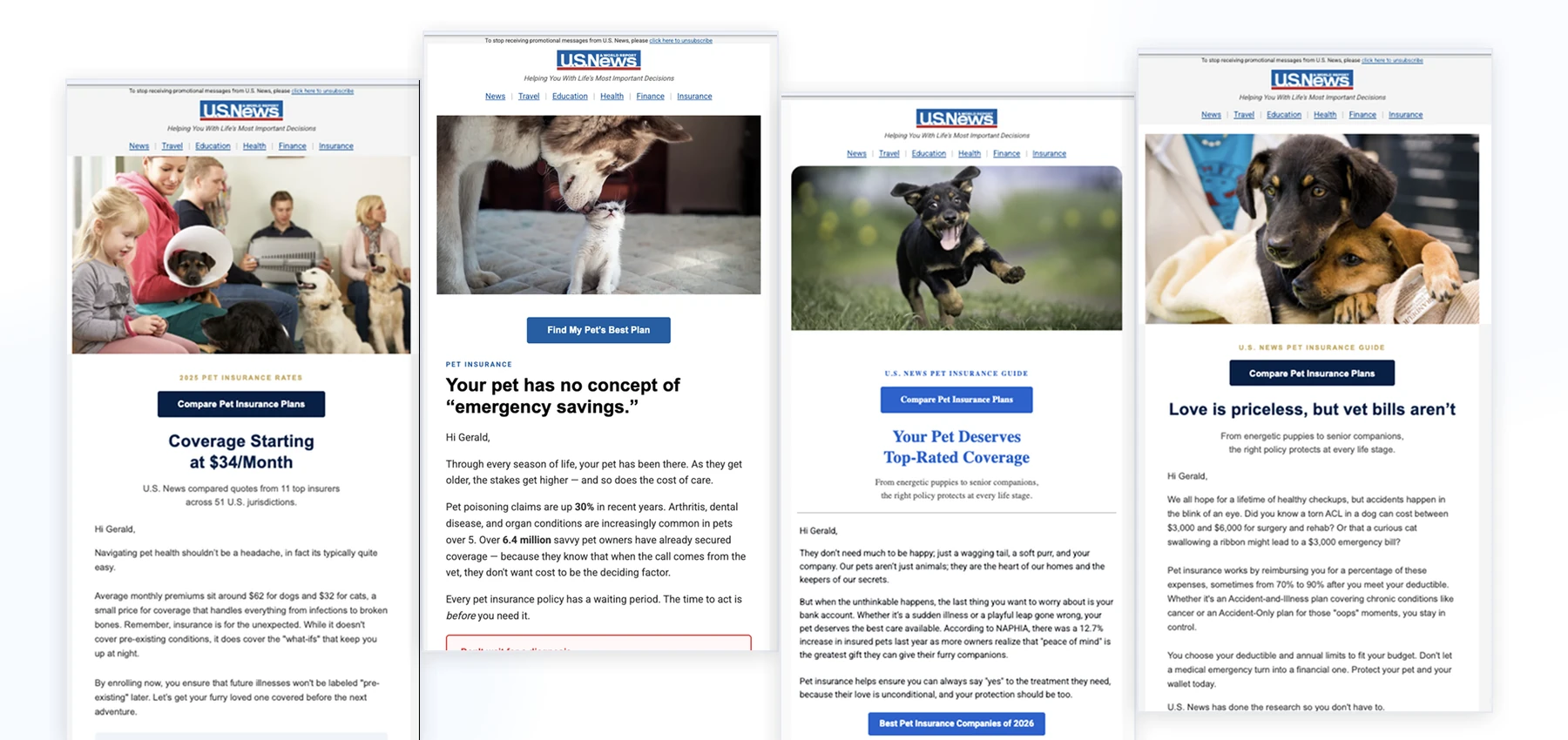
  • Saturday: Templates. Next came creative execution. Pecca described the brand guidelines and dynamic hero-image logic: a dog for dog owners, a cat for cat owners, and both for households with both. Launchpad built four fully branded pet-insurance templates in about an hour, then added charts and pricing details directly in HTML. Total time: about an hour and a half for work that would typically have gone to an HTML developer.
  • Monday: QA and launch. Before launch, Pecca ran a full audit. Launchpad caught a missing friendly-from-name and an inconsistent sending domain, then fixed both on request. A final audit came back clean.

What It Actually Delivered

The clearest measure: a 30% lift in new revenue in the first month. The campaign launched 36 new campaigns and reached 3.5M previously stale pet-owner subscribers, backed by a 48% open rate and 3.5–7% click-through rates

“I just cut my UAT from a week to hours.”

Ken Pecca, Marketing Operations Leader, U.S. News & World Report

For Pecca, the results validated more than a single campaign. After evaluating AI tooling across the martech landscape, he described Blueshift’s Launchpad as “probably the most advanced to date.”

Doubling Down

U.S. News is already applying the same agentic approach to three more initiatives: activating SMS to extend lifecycle messaging beyond email, consolidating CDP instances across its travel and cruise businesses to eliminate data silos, and piloting the AI discovery optimization tool to capture intent signals from conversational AI search platforms.

What began as a faster way to execute campaigns is now expanding into a broader approach to how U.S. News plans, builds, and grows its lifecycle marketing program.